YouTube does not participate in any kind of free video service with any cell carrier but accused T-Mobile of eating into its video streams, regardless and that too without taking the user's consent.
T-Mobile customers do get the option to turn Binge On, err, off. But, as EFF points out, "it's pretty obvious that throttling all traffic based on application type definitely violates the principles of net neutrality".
T-Mobile TMUS, -0.42% recently began offering a service that delivers video at lower quality in exchange for waiving related data fees.
"Each test was done over an HTTP connection, which allowed T-Mobile's network to observe the content of the connection and perform "optimization" (labeled "Binge On" in the graph below), and over an HTTPS connection, which prevented T-Mobile's network from observing the content of the connection, thus representing behavior without any sort of Binge-On-related optimization ('Normal')", EFF Staff Technologist Jeremy Gillula wrote today. Although customers are automatically opted into the service, Binge On can be deactivated any time. "In fact, because video is optimized for mobile devices, streaming from these sites should be just as fast, if not faster than before". The throttling speeds affected downloads as well, even when customers were downloading a browser video to watch later.
T-Mobile has not commented on EFF's net neutrality claims, but did clarify that by "optimisation", it simply meant it was reducing the bandwidth allocated to video streams. Alternatively they also note that Binge On should be an opt-in process, as opposed to opt-out as some customers might not be familiar with it. Lastly they even suggest that if T-Mobile does not do something about it, the FCC should investigate it.
"If that were true, then in the absence of higher priority traffic, videos should stream at the same throughput as any other content", he added. He told us the EFF study is a "real pinch" to T-Mobile Binge On. "Mobile optimized", T-Mobile says.
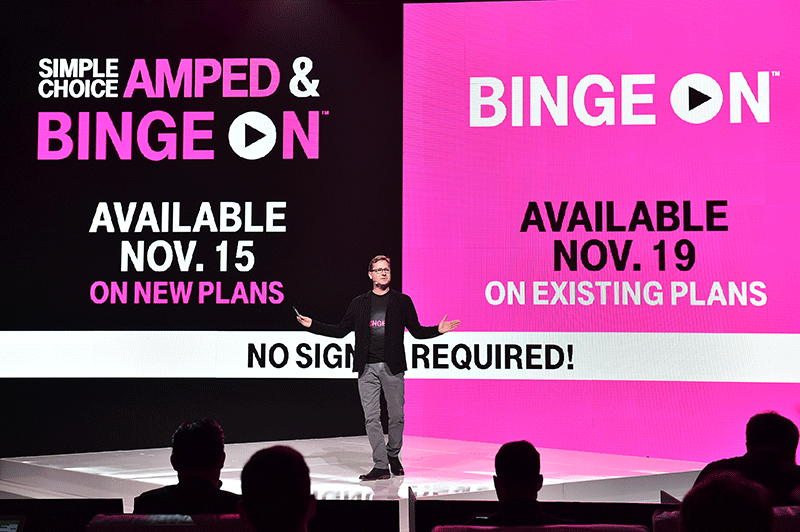
"Binge On" - which, we'll just let the ethicality and wisdom implied by that title be - enabled T-Mobile customers with data caps of over 3 gigabytes to watch unlimited videos from a chosen group of sites (24 streams on its debut, including HBO, Hulu, Netflix, ESPN, and so on) with an "optimization" cap.
"Wireless carriers need more wireless spectrum and the problem is the supply is limited". In the statement, the carrier made it clear that it was engaging in "mobile optimization", and was not throttling the video streams.
"T-Mobile has seen rapid growth in recent years, however they have very little spectrum", Kagan said.